
Gay-Identified Couples in American Cemeteries
June Hobbs, PhD | 1 April 2026
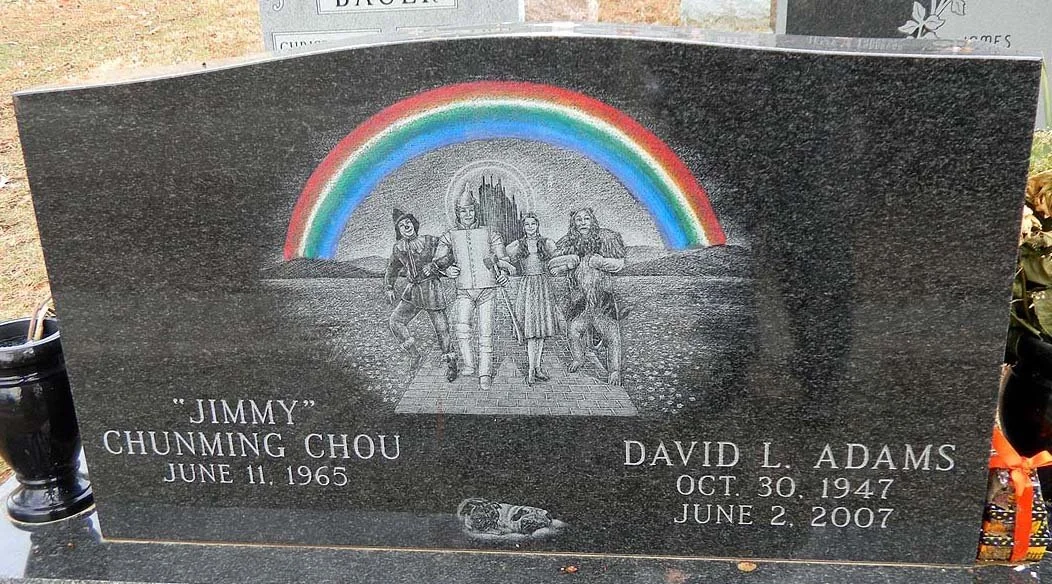
Tombstone for David L. Adams and Jimmy Chou in Rose Hill Cemetery of Bloomington, Indiana. Photo by Casey Winningham. Used by permission.
Perhaps no cliché is more obvious in American cemeteries, starting with the nineteenth century, than the idea that families belong together—even in death. But what if that family included homosexual partners in a time when same-sex unions were actively illegal in addition to being socially unacceptable?
Love did find a way. Sometimes it was just a matter of choosing the same tombstone style. Take, for example, the case of Ruth Paxon and Edith Davis, two women quietly buried side by side with identical rectangular block stones in Oakdale Cemetery in Hendersonville, North Carolina. At first glance, one might assume that Davis (1882-1944) and Paxson (1875-1949) were, perhaps, sisters, except that the epitaph on the side of Davis’ stone is from the erotic love poem Song of Solomon: “I am my beloved’s and my beloved is mine” (S of S 6:3). Ruth Paxon was a Christian missionary who spent her final years in Hendersonville as an agent of the American Bible Society, and the circular letter she sent to friends after the death of “my Edith” makes it clear that Davis was her life partner.[i]
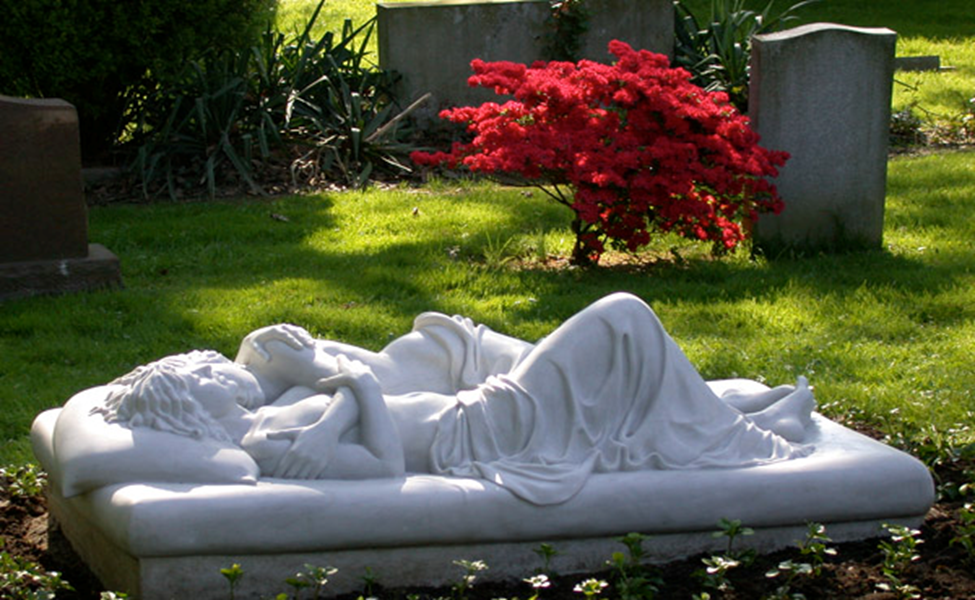
Memorial to a Marriage in Woodlawn Cemetery, the Bronx, by Patricia Cronin. Photo by Joe Edgette. Used by permission.
The artist Patricia Cronin turned her rebellion against the contradictory expectations that made burying couples together the norm while denying them the right to marry into a remarkable marble sculpture (now replaced with a bronze version) titled Memorial to a Marriage. When it was installed in Woodlawn Cemetery in the Bronx in 2003, marriage for Cronin and her partner, Deborah Kass, was not an option. Cronin describes her sculpture of two women entwined on a bed in “post-coital bliss” as her protest of what she called the “federal failure” that would not allow them to marry.[ii] She and Kass were live models for the piece.
Male homosexual couples have also rebelled against societal norms to assert that they belong together after death. One common strategy is to use gay-identified icons such as rainbows and references to the 1939 movie The Wizard of Ozon their gravestones. The movie is especially beloved in the gay community for its star, Judy Garland, whose funeral took place on June 27, 1969, the day before the Stonewall Inn riots that kicked off the gay rights movement in the United States. Judy Garland, the Dorothy of the movie, is so closely associated with queer culture that gay men have been called “Friends of Dorothy.”[iii]
By far the most politically explosive icon on gay-identified graves is the pink triangle used by the Nazis during World War II to mark gay men in concentration camps. In Cave Hill Cemetery of Louisville, Kentucky, a large pink granite triangle rests on the grave of Timothy Eskridge and the future burial place of his partner, Richard G. Coomer. Eskridge, who was suffering from AIDS, took his own life in 2002. His partner of eight years explained to a newspaper reporter that he and Eskridge “felt it was important to leave a ‘footmark that we were here . . . that gay people love and commit to each other in life and beyond death.'" The pink triangle reclaims a symbol meant to humiliate gay men and turns it into a “message of transcendence.” The words on it are the poetic English translation of the well-known statement by Pastor Martin Niemöller, a German Lutheran theologian and minister who resisted the Nazis.[iv] In the same cemetery is a pre-need tombstone for Michael Flatt and Charles Baker, Sr., erected after gay marriage was legalized. The entwined wedding rings adorning it would be completely unremarkable were they not identifying the future resting place of a gay couple.
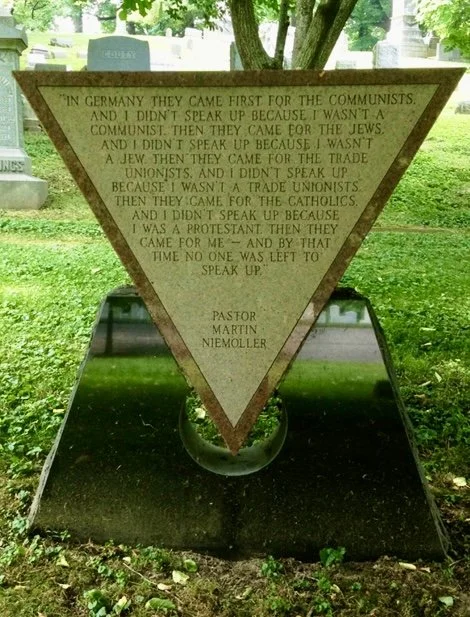
Gravestone for Timothy Eskridge and Richard G. Coomer in Cave Hill Cemetery, Louisville, Ky. Photo by June Hadden Hobbs.
[i] Ruth Paxon, Circular Letter “to Edith’s friends and mine,” Wheaton College Archives and Special Collections, Wheaton IL
[ii] Julie Bolcer, “Love and Marriage, on Display for Eternity,” Advocate.com, 21 September 2011, http://advocate.com/print/news/daily-news/2011/09/21/love-and-marriage-display-eternity.
[iii] GVGK Tang, “Reading the Rainbow: The Origins of the Pride Symbol,” National Museum of American History website, 31 May 2019, americanhistory.si.edu.
[iv] Pam Platt, “Love and the Quest for Freedom Memorialized,” Louisville Courier-Journal, 28 May 2006, H4.