Death Was Not the Beginning of Their Sacrifice
Stress, Sacrifice, and Empire in Ancient Peru
Benjamin J. Schaefer, PhD | 1 July 2026
In the arid coastal deserts of Peru, centuries-old strands of hair have begun to speak. At first glance, they seem ordinary: fine, dark, brittle with time. But within them lies a record of human experience more intimate than bones, pottery, or burial goods. These strands carry traces of cortisol, the body’s primary stress hormone, preserved within the keratin structure of hair. They hold time. They hold memory. They hold the quiet chemical evidence of what it meant to live and die under empire.1
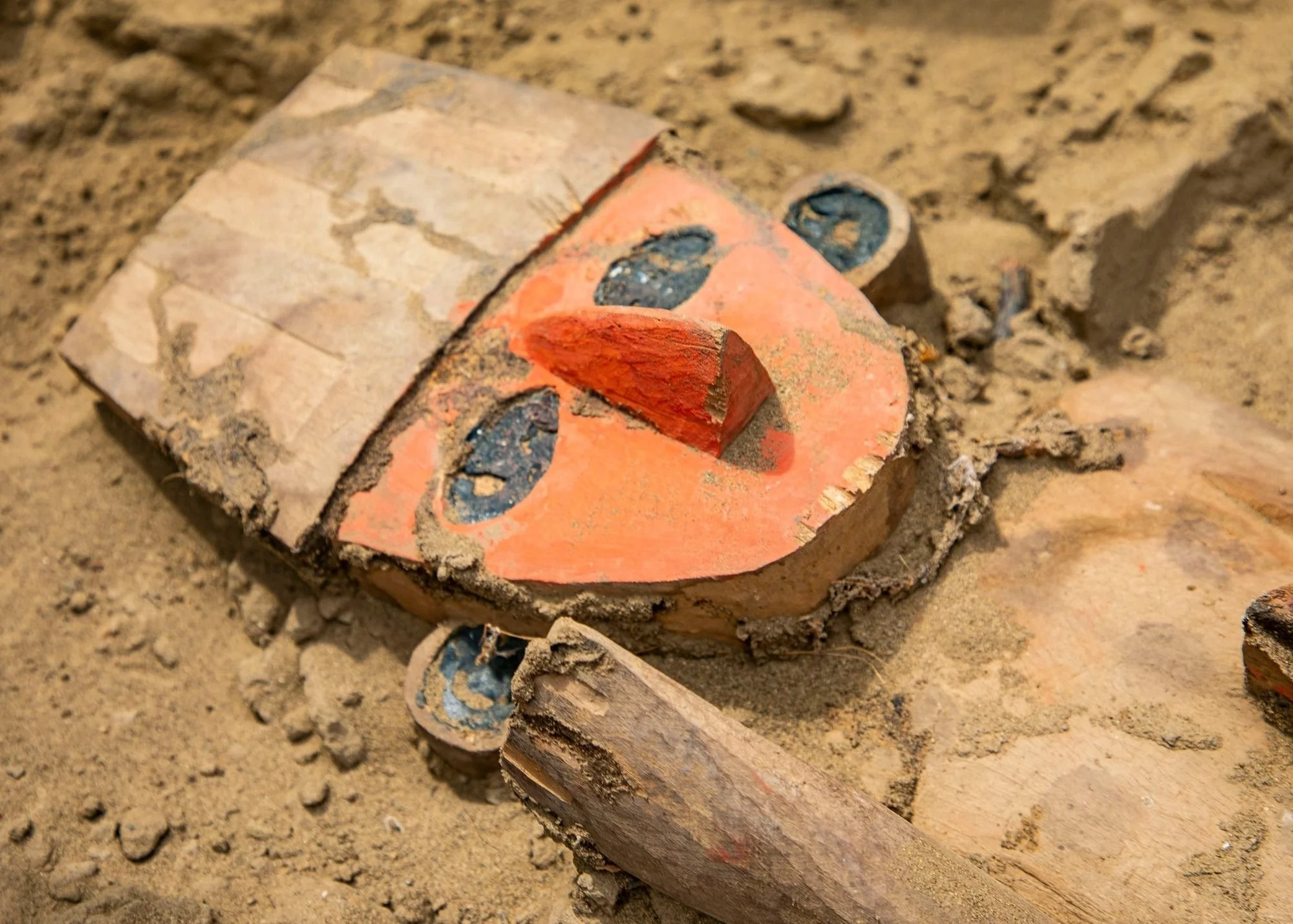
Archaeologists recovered the sculpture in association with nectandra seeds, a genus also identified in nearby Chimú burials of sacrificed children and adolescents. Peruvian Ministry of Culture. https://www.theartnewspaper.com/2022/07/07/ancient-sculpture-peru-ritual-human-sacrifice-discovered
At the site of Huanchaquito-Las Llamas, near the modern town of Huanchaco on Peru’s north coast, archaeologists uncovered one of the largest known child sacrifice events in the ancient Americas. More than 140 children and over 200 young camelids, likely llamas or alpacas, were buried in a carefully organized ritual deposit associated with the Chimú civilization.2 The children’s bodies were arranged with striking care. Many were placed facing the sea, while the camelids were oriented toward the Andes. The scene suggests a ritual that was not chaotic or improvised, but deliberate, staged, and deeply meaningful.
The Chimú Empire flourished on Peru’s north coast before the Inka conquest, with its capital at Chan Chan, one of the largest cities in the pre-Columbian Americas.3 Like many ancient states, Chimú power depended not only on armies, tribute, architecture, and administration but also on ritual. Sacrifice was one way rulers communicated with gods, responded to crisis, and made political authority visible. At Huanchaquito-Las Llamas, researchers have suggested that the mass sacrifice may have been linked to an extreme El Niño event, during which catastrophic rainfall and flooding disrupted the normally dry coastal landscape.4
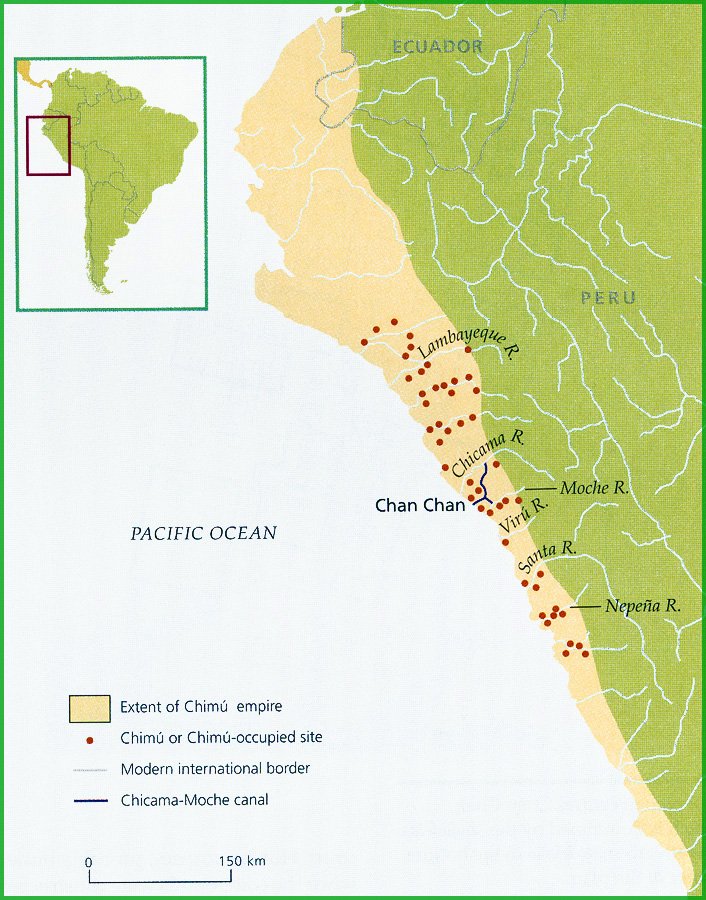
Map of the Chimú Empire (1100-1470 CE) Courtesy of https://www.latinamericanstudies.org/chimu-maps.htm
But what is often missing from archaeological discussions of sacrifice is the experience of the sacrificed themselves. We can describe how bodies were placed, how chests were opened, and how offerings were arranged. We can map a site, date its deposits, and compare burial patterns. Yet those forms of evidence often bring children into view only at the moment of death. Hair changes that. Hair allows us to ask a different question: what happened before?
Hair grows slowly, roughly month by month, and as it grows, it incorporates hormones circulating through the body. Cortisol is especially important because it plays a role in the body’s response to stress. Unlike blood or saliva, which capture short-term hormonal changes, hair can preserve a longer record. A strand several centimeters long can offer a rough timeline of stress over the final months of life.5 For archaeologists, this is extraordinary. Bones often reveal long-term health, disease, diet, or injury. Hair can bring us closer to lived experience.
In cases of child sacrifice, hair cortisol analysis can help reveal whether stress increased before death, remained consistently high, or changed suddenly. A steady rise in cortisol might suggest prolonged hardship, such as separation from family, hunger, forced travel, social isolation, or the growing uncertainty of captivity. A sudden spike might point to acute fear or trauma closer to the time of death. These patterns cannot tell us exactly what a child thought or felt, but they can show that the body was responding to pressure, threat, and disruption.6 This matters because sacrifice was not simply an event. It was a process. Children did not become offerings only at the moment a blade entered the body. They may have been selected, moved, prepared, displayed, fed differently, dressed differently, watched, confined, or ritually transformed in the days, weeks, or months before death. Their bodies were being made into offerings long before the final act. Hair preserves traces of that becoming.
The Chimú state, like many imperial regimes, understood the political power of spectacle. A child sacrifice was not only a gift to the gods. It was also a message to the living. It showed that the state could claim the most precious members of a community. It showed that families, villages, and conquered peoples were bound to a larger cosmic and political order. To offer a child was to participate in the state’s vision of balance, crisis management, and divine obligation. To lose a child was to feel Empire in the most intimate possible way.7
This is where hair becomes more than biological evidence. It becomes testimony. The cortisol stored in each strand makes visible what political systems often try to hide: fear, deprivation, grief, and a sense of loss of control. These are not abstract “stress markers.” They are embodied traces of domination. They remind us that empire does not exist only in palaces, roads, walls, and monuments. Empire also enters the body. It shapes appetite, sleep, movement, emotion, and hormone production. It becomes internal. Under the microscope, each strand becomes a narrow archive. It does not speak in words but in patterns. It records the body’s attempt to survive in the face of uncertainty. Cortisol rises when the body prepares for a threat. It helps mobilize energy, sharpen attention, and respond to danger. But when stress is repeated or prolonged, the same system can become a burden. Over time, the body carries the cost. In this sense, hair cortisol is not simply a measure of stress. It is a molecular biography of life under pressure.8
The sacrificed children of Huanchaquito-Las Llamas were not only tributes of a final ritual act. They were children whose bodies may have been shaped by the social and political conditions that preceded death. Their hair invites us to think about sacrifice as lived experience, not only as religious performance. It asks us to consider anticipation, fear, waiting, and transformation. It asks us to imagine the months leading up to the burial pit. This does not mean we can recover these children’s full stories. Archaeology always works with fragments. A strand of hair cannot tell us a name, a favorite food, a parent’s voice, or the exact meaning of a final journey. But it can tell us that the body remembered. It can show that the months before death mattered. It can insist that these children were not symbols first. They were people.9
To study hair in this way is not simply to retrieve data. It is to listen carefully to small things. It is to recognize that the body can preserve histories that official monuments never record. It is to understand that political power is not only imposed from above; it is lived through flesh, breath, hunger, fear, and chemistry. The children sacrificed by the Chimú did not survive the empire. But fragments of them did. Their hair endured in the desert long after the ritual ended, long after the mourners left, long after the state itself disappeared. Fragile and persistent, it remains both evidence and elegy. Strand by strand, it tells us that death is not the end of the archive. The body, even in fragments, still resists silence.10
Footnotes
Stalder, Tobias, and Clemens Kirschbaum. “Analysis of Cortisol in Hair: State of the Art and Future Directions.” Brain, Behavior, and Immunity 26, no. 7 (2012): 1019–1029. https://doi.org/10.1016/j.bbi.2012.02.002.
Prieto, Gabriel, John W. Verano, Nicolas Goepfert, Douglas J. Kennett, Jeffrey Quilter, Steven LeBlanc, Lars Fehren-Schmitz, et al. “A Mass Sacrifice of Children and Camelids at the Huanchaquito-Las Llamas Site, Moche Valley, Peru.” PLOS ONE 14, no. 3 (2019): e0211691. https://doi.org/10.1371/journal.pone.0211691.
Moseley, Michael E. The Incas and Their Ancestors: The Archaeology of Peru. Revised ed. London: Thames & Hudson, 2001.
Sandweiss, Daniel H., Kirk A. Maasch, Richard L. Burger, James B. Richardson III, Harold B. Rollins, and Amy Clement. “Variation in Holocene El Niño Frequencies: Climate Records and Cultural Consequences in Ancient Peru.” Geology 29, no. 7 (2001): 603–606. https://doi.org/10.1130/0091-7613(2001)029<0603:VIHENO>2.0.CO;2.
Webb, Emily, Steven Thomson, Andrew Nelson, Christine White, Gideon Koren, Michael Rieder, and Stan Van Uum. “Assessing Individual Systemic Stress through Cortisol Analysis of Archaeological Hair.” Journal of Archaeological Science 37, no. 4 (2010): 807–812. https://doi.org/10.1016/j.jas.2009.11.010.
Webb, Emily C., Christine D. White, Stan Van Uum, and Fred J. Longstaffe. “Integrating Cortisol and Isotopic Analyses of Archaeological Hair: Elucidating Juvenile Ante-Mortem Stress and Behaviour.” International Journal of Paleopathology 9 (2015): 28–37. https://doi.org/10.1016/j.ijpp.2014.12.001.
Verano, John W. “The Physical Evidence of Human Sacrifice in Ancient Peru.” In The Ancient Central Andes, edited by Jeffrey Quilter, 211–232. New York: Routledge, 2022.
Webb, Emily C., Christine D. White, Stan Van Uum, and Fred J. Longstaffe. “Integrating Cortisol and Isotopic Analyses of Archaeological Hair: Reconstructing Individual Experiences of Health and Stress.” American Journal of Physical Anthropology 156, no. 4 (2015): 577–594. https://doi.org/10.1002/ajpa.22673.
Swenson, Edward. “Ritual and Power in the Ancient Andes.” In The Oxford Handbook of the Incas, edited by Sonia Alconini and R. Alan Covey, 329–349. Oxford: Oxford University Press, 2018.
Prieto, Gabriel, John Verano, Ann Pollard Rowe, Feren Castillo, Luis Flores, Julio Asencio, Alan Chachapoyas, Victor Campaña, Richard Sutter, Aleksalia Isla, Khrysthyne Tschinkel, Rachel Witt, Andres Shiguekawa, Jordi A. Rivera Prince, Celeste Marie Gagnon, Carlos Avila-Mata, Fuyuki Tokanai, Claver W. Aldama-Reyna, and José M. Capriles. “Pampa La Cruz: A New Mass Sacrificial Burial Ground during the Chimú Occupation in Huanchaco, North Coast of Peru.” Ñawpa Pacha 44, no. 1 (2024): 69–154. https://doi.org/10.1080/00776297.2023.2221481.