
Segregating the City of the Dead
Jeffery Smith, PhD. | 1 May 2026
When noted African American abolitionist minister John Berry Meachum died while preaching from his pulpit in February 1854, his burial at Bellefontaine Cemetery in St. Louis forced the cemetery’s board to confront its views on racial segregation in the City of the Dead. The problem grew out of the seemingly innocuous creation of a special lot for Baptist clergy and their families who were active in St. Louis when they died. Bellefontaine was far from unusual in this regard; other so-called “rural cemeteries” in cities had created special lots for organizations, churches, or denominations as ways to increase business. Meachum was the minister at the First African Baptist Church—a post he had held for almost three decades. As such, Meachum met the criteria to be buried in the Baptist Minister’s Lot, so his family arranged for his interment there, and since Bellefontaine had no policy regarding the burial of African Americans, it had no choice but to allow the interment.
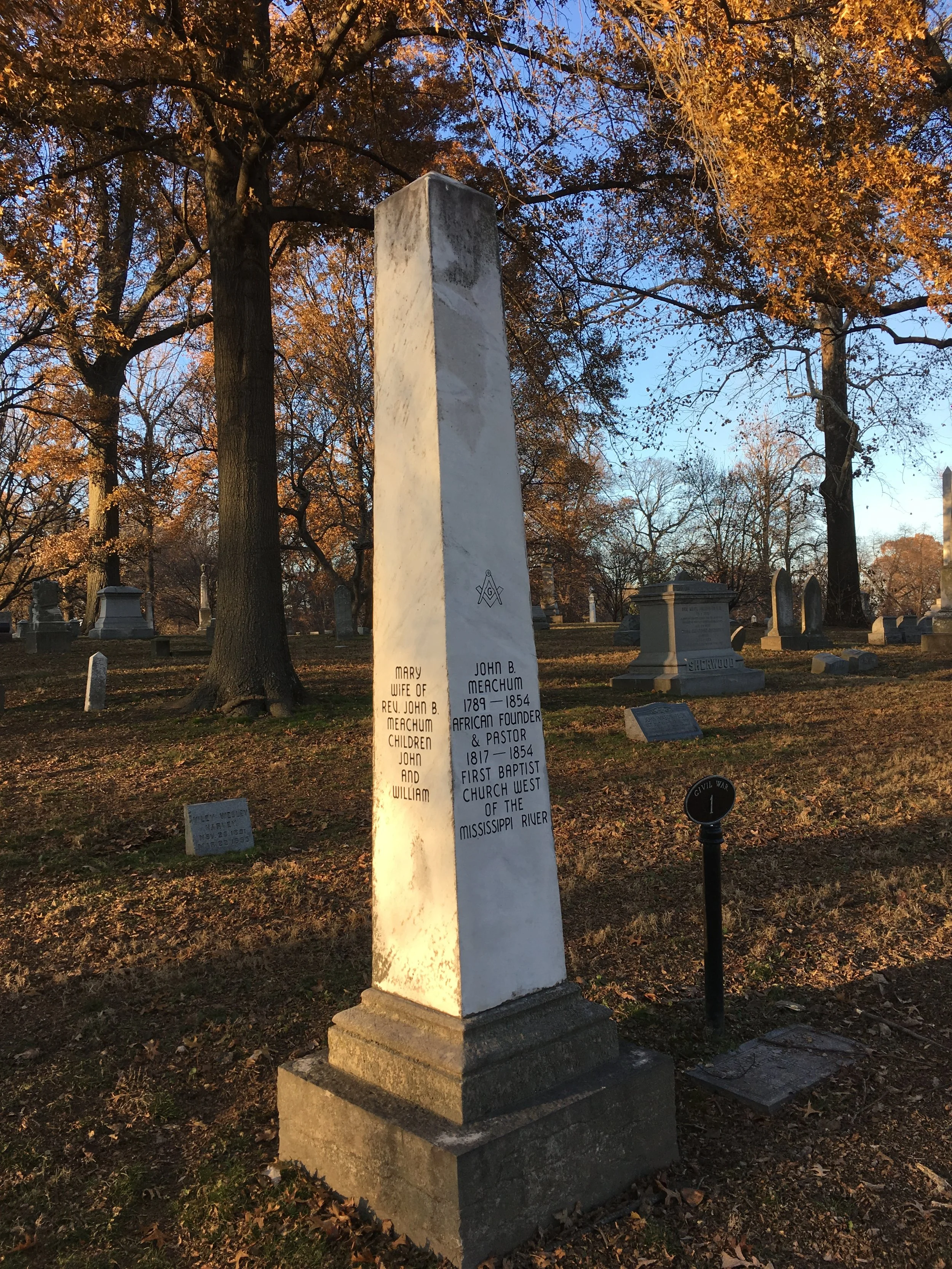
Meachum Obilisk Grave. Photo by Author 2026
John Berry Meachum (1789-1854) was not just any minister, though. He was aformer slave who purchased his freedom in Kentucky, and was perhaps the most prominent African American living in St. Louis. He and his wife Mary were vocal and active abolitionists; notice of his death even appeared on the front page of Missouri Republican.[i]Significantly, he also appears to be the first free African American to be buried in Bellefontaine. Meachum’s burial and Bellefontaine’s subsequent reaction speak to the broader contours of servitude as it applies to eternal resting places, though. When race and enslavement intersect in cemeteries, the layers of servitude and racial attitudes become more layered and complicated—and it’s not just a story of the south, or of border cities. St. Louis provides a case study.
Meachum’s burial in Bellefontaine Cemetery is the tip of a much larger iceberg regarding the nuances of race relations in a city in a border state. Burial patterns and race intersect in cemeteries like Bellefontaine in ways that point to one of the conundrums of race in American society—that the legal chronology does not always match the experiences of people living at the time. St. Louis’ population grew rapidly in the decades preceding the Civil War, so that more white people from both north and south lived in closer proximity to both free and enslaved African Americans. This rapid rise in the living population meant that the number of people of both races who died and needed to be buried rose as well. While death might be the great equalizer, the views of the living about race and slavery informed burial patterns for both races. Because the living make decisions about “eternal resting places,” cemeteries reflect the social and cultural attitudes of the broader community. Unlike any other physical manifestation of segregated society, burials represent a snapshot of views at a moment in time that does not change; while segregation among the living is more fluid—housing patterns, churches, workplaces, schools and so on change over generations—the places where the dead are buried generally do not. These cemeteries are, then, the history of race indelibly written on the landscape of cities.
When Bellefontaine opened in 1850 and Meachum died four years later, the city’s population was burgeoning, placing new pressures of burial sites. Even before St. Louis was chartered as a city in 1822, residents were figuring out that graveyards needed to be out of the way of development in part for health reasons. The Rev. Truman Marcellus Post echoed such sentiments in his sermon dedicating Bellefontaine Cemetery in St. Louis on May 15, 1850,observing “the burial place in the midst of the city soon becomes a nuisance, exhaling from its crowded graves the pestilence.”[ii]
The racial makeup of the buried population at denominational graveyards in and outside town reflected the congregational demographics. A few were buried in the Episcopal and Catholic cemeteries, but most were interred in either the Methodist cemeteries or those operated by the City. When the newly elected St. Louis City Council convened for the first time in April 1823, it began the task of creating a well-regulated community, dealing with the problems its members thought were highest priorities. Its second order of business (after banning gambling tables and games of chance) prohibited burials within the city limits with stiff penalties.[iii] Two decades later, the ban was apparently ineffective. The City regulated all “public graveyards” with two ordinances in 1843. Ordinance 1666, required reports in which “the deaths shall be set forth under the three separate heads of ‘White,’ ‘Free Colored,’ and ‘Slaves.’”[iv]Denominational cemeteries, on the other hand, were either originally or relocated outside the city limits, keeping decomposing bodies a safe distance from the living.
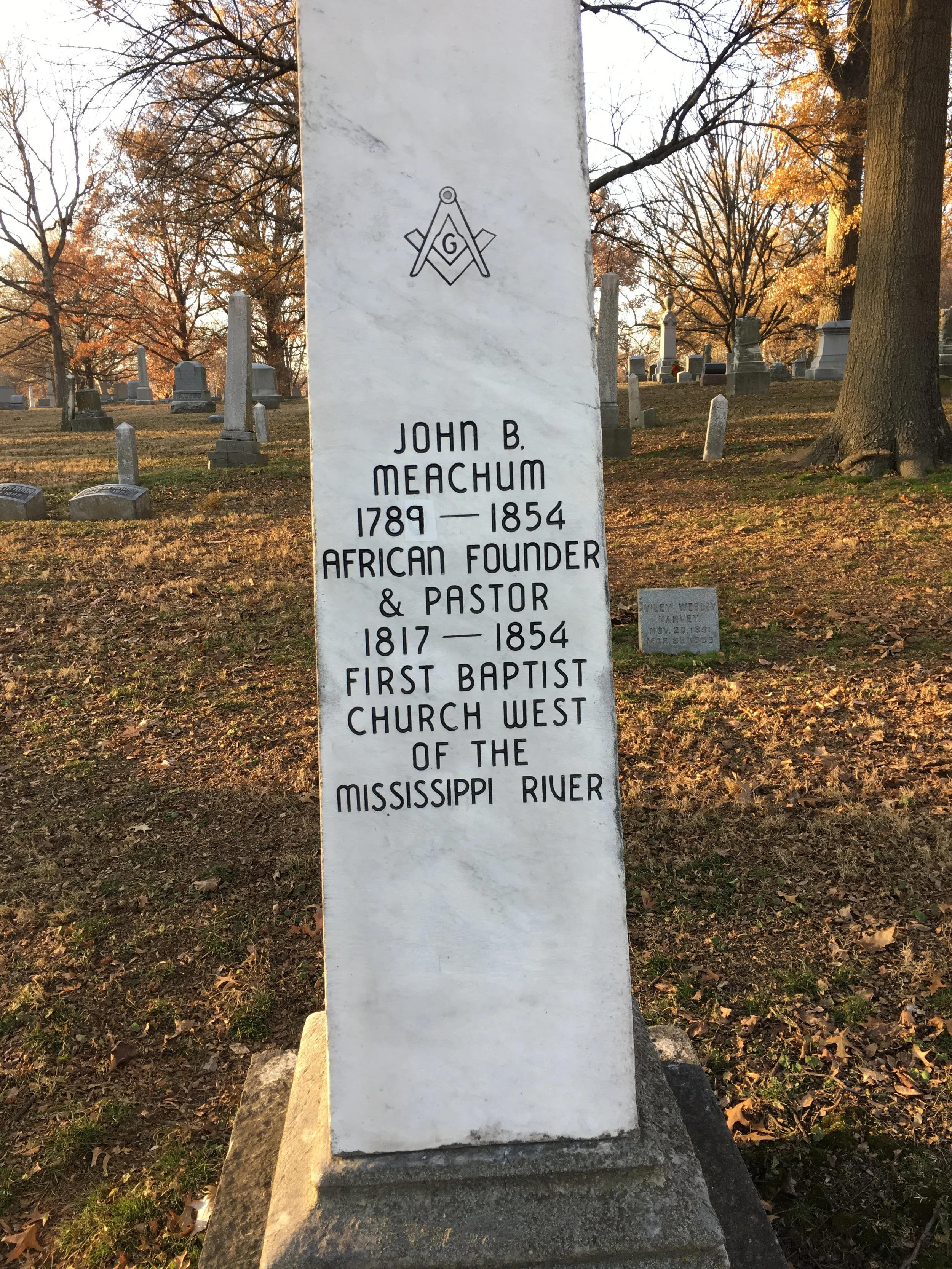
Meachum Obilisk Grave. Photo by Author 2026
While most people in St. Louis buried their dead in denominational graveyards operated by the Catholic, Methodist, German Evangelical, Presbyterian, and Episcopalian churches, not everyone used them. The city council created its second City Cemetery in 1836, and placed it in the common fields southwest of town at present-day Jefferson Avenue and Arsenal Street, the site of today’s Benton Park.[v] City fathers clearly saw the City Cemetery as primarily for outsiders of sorts: free blacks, slaves, individuals, or “strangers” (a euphemism for those who died poor, alone, or both) who were most likely either Protestant or those without church affiliation. Bellefontaine was one response to the need for more burial space, but because people had to pay for burials there, it excluded the poorest swath of the population. The city council responded in part with its Sublette Cemetery that served as a “potter’s field” for the indigent before the Civil War, but apparently used it for less than a decade. The burial records, albeit incomplete, suggest the demographics of the city, though. The number of free blacks (about 11 percent of the burials) is disproportionately high compared to the general population, and the number of slaves (three percent) roughly parallels the percentage of the city’s population that was enslaved.[vi]
Before Bellefontaine opened, most African Americans were buried in the Wesleyan Cemetery on Grand Avenue (on today’s St. Louis University campus), chartered in 1847 as the burial ground for Methodists from the congregations and missions that grew out of the Fourth Street Methodist Church. As St. Louis grew rapidly, Fourth Street Methodist outgrew several buildings in between its first meetings in a log cabin in 1820 and mid-century. Its 1822 building, the first church erected by the Methodists in St. Louis, included a gallery on three sides for both free blacks and slaves. It built another larger church in 1830, and soon thereafter constructed a small church for African Americans.[vii] Even though Fourth Street became First Methodist Church-South when the Methodists voted overwhelmingly to split over the issue of slavery in 1845, the two congregations remained yoked through shared clergy, tradition, and slave ownership. Wesleyan Cemetery became the burial ground for congregants from both churches. The cemetery was segregated, just as were two the churches. Between 1847 and 1851, 89 percent of African Americans at Wesleyan were interred in blocks 27 and 28, and all suggest a similar story: almost all the African American burials give no grave number, and the few that do are almost all in those two lots. Almost half of African American buried there can be readily identified as slaves.[viii] Several owners who used Wesleyan also sat on the board of directors of Bellefontaine Cemetery or owned family lots there, but chose to use Wesleyan instead, perhaps because their slaves attended the AME church.
Like its rural cemetery counterparts in other cities, Bellefontaine was a private, chartered, and nondenominationalinstitution for people of all faiths, despite carrying out what we associate with a sacred function. Typically, the price structure of burial sites as these rural cemeteries separated people by socioeconomic class. Unlike the old City Cemetery which had two prices (adults and children), Bellefontaine had separate prices for “lots” which were sold by the square foot with rights that paralleled those of property owners, individual graves in designated “public lots,” and later groupings of plots called “sectional lots.”[ix]
Part of a slave owner’s obligation was burying slaves’ remains when they died. Large plantations like Monticello or Mount Vernon had separate graveyards for slaves, rural owners and planters buried slaves in country burial grounds, but urban slave owners did not enjoy such available land. In the case of St. Louis, some opted for the inexpensive lot in the City Cemetery or a denominational cemetery. A handful of family lots in Bellefontaine have slaves buried on them, many identified in interment records, maps of family lots, or both. The first appears to be 15-year-old George, identified as “Slave of L. M. Kennett” who died in late 1853. However, George’s remains are no longer on Luther Kennett’s lot, apparently disinterred and moved elsewhere.[x] When three-year-old Louisa died in 1860, the interment records identified her as “Slave of M. Weber,” within burial Lot 374 showing her last name as “unknown.” Four years later, when Georgiana Wagner died in August 1864, she was identified as “slave” when buried on the same lot.[xi] Others appear, some marked, most not. Perhaps the most striking case is that of Nellie Warren, a slave owned by the Collier family, who died at age 73 in 1857. The stone monument identifies her as “Aunt Nellie” and “colored.” Moses Bailey was the last slave buried in Bellefontaine, who died in November 1864 at age 60 just two months before the new Missouri Constitution banned the peculiar institution.[xii] Bailey was somewhat typical of the slave experience at Bellefontaine. He was buried on the large family lot purchased by his owner, William N. Switzer. Next to Bailey are two other slaves—Ellen, 23, and Ada, 20 months, both of whose last names were listed at the time as “unknown,” both noted as “slave of W. N. Switzer.”[xiii]Their graves are all the way in the back of the large lot, in unmarked graves, as far from the family as possible; segregation followed them even to the grave. The story of Moses Bailey, Ellen, and Ada is not unusual. Of the limited number of African Americans buried in Bellefontaine, almost all were either current or former slaves. By was of comparison, the experience of Calvary Cemetery, the Catholic garden cemetery across the street, has some 35 African American burials, ten of whom were slaves.[xiv] This handful of owners at both cemeteries appears to be the exception rather than the rule. The burial site for slaves in cities like St. Louis was selected not by the deceased, but by the owners who had to bury their slaves someplace. Because they made the decisions, their views about race informed the locations of slaves’ burials. Antebellum cities like St. Louis were not necessarily segregated; owners and other whites routinely saw and interacted with slaves and free blacks as they might have in, say, a plantation setting. Owners rented slaves to others for various tasks or duties, and used them in households. While contact was fairly constant, it was always unequal, of course. Just as owners made decisions for slaves in life, so too did they make them regarding death and burial. In other words, every one of those slaves buried on owners’ lots in Bellefontaine was interred not by their own volition but a decision of their owners. Given the view in both law and society that slaves were property, it is not so striking that so few slaves are buried on family lots as it is that any are buried there at all. The number of slaves buried at Bellefontaine is about the same as at the city’s Potter’s Field, but is proportionately smaller by 14-fold.[xv]
There exists nothing in the record to suggest that the founders of Bellefontaine gave any thought to race, even though nine of the original founders owned slaves in 1850 and eight still did in the 1860 census. At no point did they address race in the published rules or set aside a special section for African Americans—at least until 1854, after Meachum’s death forced their hand. At the board meeting on April 24, the very first one after Meachum’s death, Gerard Allen proposed a ban on burying free blacks or using the Receiving Tomb, “Provided,” he wrote, “that this resolution shall not be so construed to prevent any lot owner from depositing the body of any colored person within his own lot.” A discussion followed, apparently about the absolute clarity of the board’s intentions, since it passed a substitute resolution: “no colored person shall be interred in the grounds of this Association or deposited in the Receiving Tomb, except slaves in the lots of their masters, unless this Board shall by special resolution authorize the same.”[xvi] In death as in life, racial integration was acceptable in antebellum St. Louis so long as the unequal relationship was maintained. To make sure such breaches did not happen again, the board gave William McPherson (one of the cemetery’s founders) control of the Baptist Lot as trustee during his lifetime.[xvii] The resolution remained the policy of Bellefontaine Cemetery until May 1878 when it voted unanimously “that the resolution adopted by this Board on 24 April 1854, in reference to the depositing in Receiving Tomb, and interment in the cemetery, of the remains of Coloured [sic] Persons, be and the same is rescinded.”[xviii]
So, why change now? That’s when the remains of Robert, a former slave of board member Wayman Crow, were moved to the public lots. Crow had purchased one of the first family lots in June 1850, and over the next two-plus decades buried ten people on it. But in 1878, he purchased a new and larger one on a bluff overlooking the Mississippi River and, since he had to completely vacate Lot 15 in order to return it to the Association for resale, he moved six of the bodies of family members to the new lot in the spring of 1879. Two more were moved to other family lots. But there was a problem with one more: “Robert (Servant)” who died in 1870—and was listed in the interment books as “Servant of W. Crow” even though he died five years after emancipation— had to be removed as well. By 1878, Crow apparently felt less of an obligation to keep Robert near the family, but cemetery policy through its 1854 resolution precluded moving his remains anywhere but another family lot. The board voted in 1878 to allow the burial of African Americans in the cemetery within only months after Crow purchased his new lot. Robert was removed to the inexpensive Public Lot in 1879 and interred in a sea of unmarked graves on the northern edge of the cemetery, just a few rows from Calvary Avenue.[xix]
Crow’s was not the only story like this. Other descendants ordered the removals of ancestors’ servants as well. Consider William Poulterer. Two of his slaves died in the mid-1850s—22-year-old Samuel (of pneumonia) in 1855 and five-year-old Pete (of whooping cough) two years later—and were buried in Wesleyan Cemetery. Poulterer purchased lot 708 in late 1857 to bury his one-year-old daughter Annie; in January 1858, he moved the remains of the two slaves, clearly intending to use the lot for the family. Yet no one else was buried on the lot; in 1910, the heirs surrendered the lot to Bellefontaine, removed Annie’s remains from the cemetery (the records are silent on where), but had the two slaves reinterred in unmarked graves in one of the public lots, just like Robert.[xx] While slave owners may have referred to servants as “members of the family” and may have even felt emotional ties to them, those bonds did not transcend time. The inferior social status of slaves did.
Urban slavery introduced a vexing problem for both former slaves and former owners. The new Missouri Constitution banned slavery in January 1865, but it failed to address what would happen to former slaves. Some left town, of course, and others moved out of their former owners’ homes and took jobs elsewhere in the city. But some continued in the employ of their former masters, and still others continued to maintain looser ties to their former owners. When Patience (no last name given) died in 1871, for example, she was buried in Lot 63 owned by her former owners, the Chambers family. Her gravestone gives only her first name, identifies her as “Faithful and Loyal Servant,” and is far from the family at the opposite side of the lot.[xxi] Patience was 59 when slavery ended in Missouri, and apparently stayed on as a servant for the family for the remainder of her years. It is hard to determine the nature of the relationship, but one can imagine the household feeling it needed help; Patience may have felt short on options and perhaps even trapped, and the family may have even felt an emotional tie to a long-time slave. At the day-to-day life level, freedom was probably a complicated notion to some urban slaves like Patience, and when she died she may have been buried with the family, but she was just as separate and unequal in death as in life.
Others retained some sort of ties to their former owners. Two former slaves are buried on the lot for explorer and territorial governor William Clark lot, for example. At the time of her death Emma Payne, 59, lived on Gay Street when she died in 1876. When Lewis Wilson died three years later, he was buried next to her after having been her neighbor in life. Most striking are their epitaphs on the gravestones: Payne’s reads “A Good and Faithful Servant” and Wilson’s “Retainer of the Family.”[xxii] Like Patience, Wilson and Payne are buried at the back of the lot, farthest away from the entrance to the explorer’s lot. They face the opposite direction from the others, just like Patience’s. Slavery may have ended, but those relationships died hard.
Patience. Emma Payne. Lewis Wilson. Nelly Warren. All slaves or former ones; and all buried with their current or former masters’ families, all suffering the final degradation of slavery of being buried in subservience. But the story of race and burial patterns in border cities is more nuanced. The significant point is that the locations of all interments are mediated—that is, they are ultimately decided by the living. Those who purchased large family lots at places like Bellefontaine, Calvary, or other gardenesque cemeteries chose the sites of those lots within the cemeteries, ensuring that their eternal homes were in neighborhoods of their own choosing. For everyone else buried there and in other graveyards, survivors chose the locations of graves. In the case of African Americans, social conventions about race and slavery dictated those locations. After the death of John Berry Meachum, white board members at Bellefontaine Cemetery decided which African Americans could be buried in “their” cemetery. In a similar way, white church elders decided where black Methodists could worship and where in the denominational graveyard they could be buried. Only the graveyard for the most impoverished included both races, and the record is silent if they were segregated by race—and even they were identified by race and status (slave or free) in the interment records. Because burials are a “final resting place,” the locations make relationships permanent, and become a lasting image of race relations in a border state, where even death kept the races apart.
[i] “John Berry Meachum,” Missouri Republican, February 20, 1854.
[ii] Scipione Piattoli, Essay on the Danger of Interment in Cities was first published in the United States in 1823; “The Bellefontaine Cemetery,” Missouri Republican, May 16, 1850.
[iii]Ordinances passed by the Mayor and Board of Aldermen of the City of St. Louis (St. Louis: Edward Charles, 1824), 10-12.
[iv] “An Act to Amend an Act Concerning Bills of Mortality, in the City of St. Louis and Suburbs,” Ordinance 16666, Ordinances compiled in 1846, 84, 105-6.
[v]Ordinances of the City of St. Louis, Passed Since the Publication of the Revised Code of 1836; and, also, Such Ordinances upon Special Subjects, now in Force (St. Louis: Office of the Missouri Argus, 1838), 31-2. The City Council closed the City Cemetery in 1865 and transformed it into City Park (later renamed Benton Park after former Senator Thomas Hart Benton) in 1866.
[vi] The records for Sublette Cemetery are digitized by the St. Louis Genealogical Society; see http://stlgs.org/research-2/life-death/cemeteries-2/st-louis-area-cemeteries-list/city-cemetery-sublette-cemetery-c15.
[vii] John Emory Godbey, History of the First M.E. Church, South, St. Louis, Mo. (St. Louis: n.p., 1879), 16-26.
[viii] “List of Colored Persons in Wesleyan Cemetery, chronological order, 1847-1851” and “List of Colored Persons in Wesleyan Cemetery, chronological order, 1852-1854,” St. Louis County Library, Julius K. Hunter Collection. Some are explicitly identified as “Negro of” or “servant of” someone, while others included give only a first name, suggesting they were slaves.
[ix] “Lots” refers to larger parcels within a cemetery where multiple bodies can be buried. Usually, families purchased these lots; by the 1860s it was not unusual for them to have a larger family marker with smaller individual ones surrounding it, and sometimes enclosed by iron fences or stone copings. Individual burial spaces were often called plots, and were generally located in less prestigious areas devoted exclusively to those individual graves. See Rules and Regulations of the Bellefontaine Cemetery, with the Charter, Amendments to the Charter, and Catalogue of Proprietors, to July 1, 1862 (St. Louis: R. P. Studley and Company, 1862). This sort of pricing structure to segregate classes was typical of picturesque cemeteries like Bellefontaine.
[x] Interment Records, Bellefontaine Cemetery; Bellefontaine Cemetery Lot File 341. Luther M. Kennett (1807-1873) was a prominent political figure in St. Louis, serving as both mayor and congressman during the 1850s. While a Whig, he also gained support from the Know-Nothing wing of the part.
[xi] Interment Records, Bellefontaine Cemetery.
[xii] However, the 13th Amendment passed the U.S. House of Representatives in late January 1865.
[xiii] In the interment books, some slaves have no surname listed, while others will be listed as “Unknown.” Contemporary records list last names for Ellen and Ada as Switzer, the same as their owner.
[xiv] Interment Records of Bellefontaine Cemetery; Bellefontaine Cemetery Lot File 153. The Rev. John Berry Meachum was the most notable exception; Catholic Cemeteries of the Archdiocese of St. Louis, Calvary Cemetery Burial Records.
[xv] The 13 slaves buried at Sublette Cemetery constituted about three percent of the 343 recorded burials, whereas the 17 slaves buried at Bellefontaine represents only .2 percent of the more than 8,200 burials by 1865. St. Louis Genealogical Society Cemetery Records, http://stlgs.org/research-2/life-death/cemeteries-2/st-louis-area-cemeteries-list/city-cemetery-sublette-cemetery-c15; Interment Records of Bellefontaine Cemetery.
[xvi] Bellefontaine Cemetery Board Minutes, April 21, 1854; Dennis L. Durst, “The Reverend John Berry Meachum (1789-1854) of St. Louis: Prophet and Entrepreneurial Black Educator in Historiographical Perspective,” The North Star: A Journal of African American Religious History 7 (Spring 2004): 1-24. Gerard Allen (1813-1887) was a St. Louis businessman who was among the founders of Bellefontaine Cemetery.
[xvii] Bellefontaine Cemetery Executive Committee Minutes, June 8, 1897.
[xviii] Board Minutes, May 1, 1878; italics in the original.
[xix] Bellefontaine Cemetery Lot File 189; Interment Records of Bellefontaine Cemetery.
[xx] Interment Records of Bellefontaine Cemetery.
[xxi] Interment Records of Bellefontaine Cemetery.
[xxii] Ibid.; Bellefontaine Cemetery Lot 780.